Exam Platform
Looking to improve your numerical aptitude? This complete guide explains the numerical aptitude meaning, syllabus, essential topics, formulas, practice questions, and expert tips to help you strengthen your numerical ability and succeed in aptitude tests.
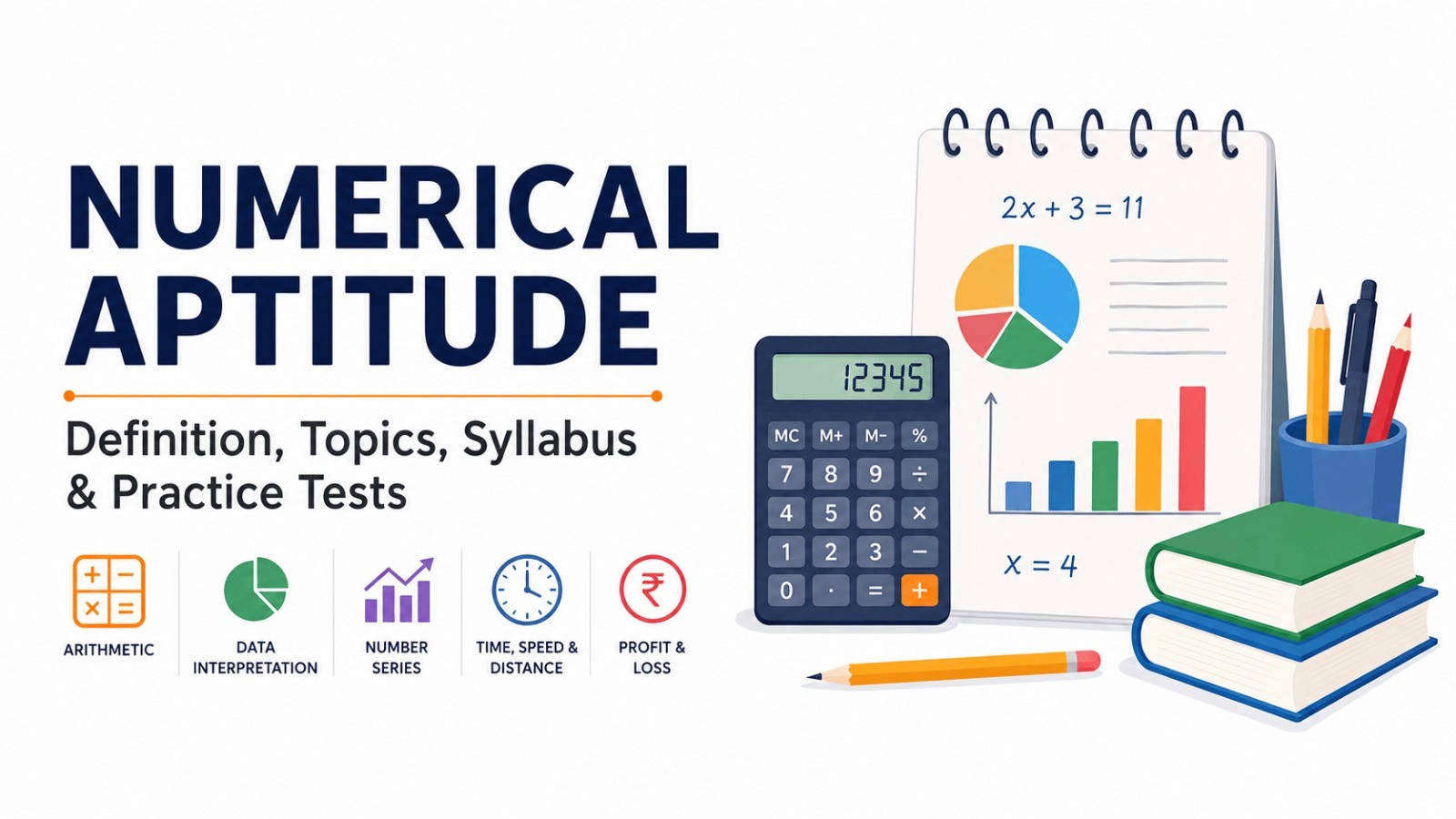

Numerical aptitude is one of the most important skills assessed in competitive exams, campus placements, government recruitment, and corporate hiring. It is one of the most commonly evaluated types of aptitude tests, designed to measure your ability to work with numbers accurately and efficiently. If you're new to aptitude assessments, you can first explore what is an aptitude test to understand how these assessments help evaluate a candidate's skills and suitability for different roles.
Unlike advanced mathematics, numerical aptitude focuses on solving real-world numerical problems using logical thinking, arithmetic operations, and data analysis. It tests how quickly you can interpret numbers, perform calculations, identify patterns, and make decisions based on quantitative information.
In this guide, you'll learn the numerical aptitude meaning, explore the complete numerical aptitude syllabus, understand the difference between numerical aptitude and mathematical ability, and discover practical strategies to improve your performance. You'll also find important formulas, practice questions with answers, expert preparation tips, and frequently asked questions to help strengthen your numerical ability and perform confidently in any numerical aptitude test.
What Is Numerical Aptitude? (Definition)
Numerical aptitude is the ability to understand, interpret, analyze, and solve problems involving numbers. It measures how effectively a person performs arithmetic calculations, identifies numerical patterns, interprets data, and applies mathematical concepts to practical situations.
A numerical aptitude assessment doesn't require advanced mathematical knowledge. Instead, it evaluates your ability to use basic mathematical concepts accurately and efficiently under time constraints.
Numerical Aptitude Meaning in Simple Words
In simple terms, numerical aptitude refers to your ability to work comfortably with numbers.
For example, if you can:
Calculate percentages while shopping
Compare discounts quickly
Interpret graphs and charts
Estimate travel time based on speed and distance
Solve ratio or average problems
Analyze sales or financial data
then you're demonstrating good numerical aptitude.
What Does a Numerical Aptitude Test Measure?
A numerical aptitude test evaluates several quantitative skills, including:
Skill | What It Measures |
Arithmetic skills | Basic calculations involving percentages, ratios, fractions, decimals, and averages |
Numerical reasoning | Ability to identify relationships and solve number-based problems |
Data interpretation | Understanding tables, graphs, and charts |
Logical calculations | Solving numerical problems efficiently |
Speed and accuracy | Completing calculations correctly within a limited time |
Why Is Numerical Aptitude Important?
Strong numerical ability is valuable across both academic and professional settings because it helps individuals:
Make informed decisions using data
Solve quantitative problems efficiently
Improve logical thinking
Analyze financial and business information
Perform better in aptitude examinations
Handle workplace calculations with confidence
Many organizations consider numerical aptitude an essential employability skill because today's jobs increasingly rely on data-driven decision-making.
Numerical Aptitude Syllabus — All Topics Covered
The numerical aptitude syllabus varies slightly depending on the examination or recruitment process. However, most competitive exams and employment assessments cover a common set of arithmetic and numerical reasoning topics.
Understanding these topics helps candidates create a structured preparation strategy and identify areas that require additional practice.
The core syllabus generally includes:
Basic arithmetic
Percentages
Fractions and decimals
Ratios and proportions
Profit and loss
Simple and compound interest
Averages
Time, speed and distance
Time and work
Number systems
Data interpretation
Number series
Simplification
Approximation
Mensuration
Probability (basic level)
Permutation and combination (selected exams)
Below are the most commonly tested topics.
Basic Arithmetic (Percentages, Ratios, Averages)
Basic arithmetic forms the foundation of every numerical ability test. Most questions in competitive exams directly or indirectly rely on arithmetic concepts.
1.1 Percentages
Percentage questions assess your ability to compare values and calculate increases, decreases, discounts, profits, and interest.
Common applications include:
Discount calculations
Exam scores
Population growth
Salary increments
Tax calculations
Example:
A laptop priced at ₹50,000 is available at a 15% discount.
Discount = ₹7,500
Final price = ₹42,500
1.2 Ratios and Proportions
Ratio questions evaluate how two or more quantities compare with one another.
Typical problems include:
Dividing amounts
Mixture questions
Partnership problems
Age-related questions
Example:
The ratio of boys to girls in a class is 3:2.
If there are 30 boys, the number of girls is:
30 × 2 ÷ 3 = 20
1.3 Averages
Average questions determine your ability to calculate the central value of a data set.
Formula:
Average = Sum of observations ÷ Number of observations
Example:
Marks scored:
70, 75, 80, 85, 90
Average = 80
Data Interpretation
Data Interpretation (DI) measures your ability to analyze numerical information presented in different formats.
Instead of performing complex calculations, these questions assess how effectively you understand data and draw conclusions.
Data may appear as:
Tables
Bar graphs
Pie charts
Line graphs
Mixed charts
Candidates are typically asked to calculate:
Percentages
Ratios
Growth rates
Averages
Differences
Total values
Example
A company's quarterly sales are:
Q1: 120 units
Q2: 150 units
Q3: 180 units
Q4: 210 units
Question:
What is the percentage increase in sales from Q1 to Q4?
Answer:
Increase = 210 − 120 = 90
Percentage increase = (90 ÷ 120) × 100 = 75%
Strong data interpretation skills are particularly valuable in finance, analytics, consulting, business management, and data-driven roles.
Number Series
Number series questions evaluate your ability to identify logical numerical patterns. Candidates must determine the missing number or identify the next number in a sequence.
Common patterns include:
Addition
Subtraction
Multiplication
Division
Squares
Cubes
Prime numbers
Alternating sequences
Example:
3, 6, 12, 24, ?
Answer:
48
Each number doubles the previous one.
Time, Speed & Distance
This topic evaluates how effectively candidates solve motion-related numerical problems.
The three variables are interconnected:
Speed = Distance ÷ Time
Distance = Speed × Time
Time = Distance ÷ Speed
Typical question types include:
Relative speed
Trains
Boats and streams
Average speed
Race problems
Example:
A car travels 180 km in 3 hours.
Speed = 180 ÷ 3 = 60 km/h
Profit & Loss
Profit and loss questions assess commercial arithmetic and everyday financial calculations.
Candidates should understand concepts such as:
Cost Price (CP)
Selling Price (SP)
Profit
Loss
Discount
Marked Price
Basic formulas include:
Profit = SP − CP
Loss = CP − SP
Profit % = (Profit ÷ CP) × 100
Loss % = (Loss ÷ CP) × 100
Example:
A shopkeeper buys a product for ₹800 and sells it for ₹920.
Profit = ₹120
Profit Percentage = (120 ÷ 800) × 100 = 15%
Numerical Aptitude Formulas: A Complete Cheat Sheet
Topic | Formula |
Percentage | Percentage = (Part ÷ Whole) × 100 |
Percentage Increase | ((New Value − Original Value) ÷ Original Value) × 100 |
Percentage Decrease | ((Original Value − New Value) ÷ Original Value) × 100 |
Average | Average = Sum of Observations ÷ Number of Observations |
Ratio | Ratio = First Quantity : Second Quantity |
Profit | Profit = Selling Price (SP) − Cost Price (CP) |
Loss | Loss = Cost Price (CP) − Selling Price (SP) |
Profit Percentage | (Profit ÷ Cost Price) × 100 |
Loss Percentage | (Loss ÷ Cost Price) × 100 |
Discount | Discount = Marked Price − Selling Price |
Discount Percentage | (Discount ÷ Marked Price) × 100 |
Simple Interest (SI) | SI = (P × R × T) ÷ 100 |
Compound Interest (CI) | CI = Amount − Principal |
Compound Amount | A = P × (1 + R/100)T |
Speed | Speed = Distance ÷ Time |
Distance | Distance = Speed × Time |
Time | Time = Distance ÷ Speed |
Time & Work | Work Done = Time Worked ÷ Total Time |
Pipes & Cisterns | Filling Rate = 1 ÷ Time Taken |
Partnership | Profit Share = Investment × Time |
Mixture | Quantity × Concentration = Pure Substance |
HCF & LCM | Product of Two Numbers = HCF × LCM |
Probability | Probability = Favourable Outcomes ÷ Total Outcomes |
20 Numerical Aptitude Questions (Beginner to Advanced)
Beginner Level Numerical Aptitude Test (Questions 1–7)
1. Percentage
A laptop originally costs ₹60,000. During a sale, it is offered at a 15% discount.
What is the selling price?
A. ₹49,000
B. ₹50,000
C. ₹51,000
D. ₹52,000
2. Average
The marks scored by five students are:
58, 72, 65, 80, 75
What is their average score?
A. 68
B. 69
C. 70
D. 71
3. Ratio
The ratio of boys to girls in a class is 7:5. If there are 42 boys, how many girls are there?
A. 28
B. 30
C. 32
D. 35
4. Profit & Loss
A shopkeeper purchases a watch for ₹1,250 and sells it for ₹1,500. What is the profit percentage?
A. 15%
B. 18%
C. 20%
D. 25%
5. Simple Interest
Find the simple interest on ₹12,000 at 8% per annum for 3 years.
A. ₹2,400
B. ₹2,640
C. ₹2,880
D. ₹3,000
6. Time, Speed & Distance
A train covers 360 km in 6 hours. Its average speed is:
A. 50 km/h
B. 55 km/h
C. 60 km/h
D. 65 km/h
7. Number Series
Find the next number.
4, 9, 16, 25, 36, ?
A. 42
B. 45
C. 49
D. 64
Intermediate Level Numerical Aptitude Test(Questions 8–14)
8. Compound Interest
What is the compound interest on ₹10,000 invested for 2 years at 10% per annum, compounded annually?
A. ₹2,000
B. ₹2,050
C. ₹2,100
D. ₹2,150
9. Data Interpretation
The monthly sales (in lakh rupees) of a company are:
Month | Sales |
Jan | 45 |
Feb | 50 |
Mar | 60 |
Apr | 75 |
What is the percentage increase in sales from January to April?
A. 50%
B. 60%
C. 66.67%
D. 75%
10. Mixture
Milk and water are mixed in the ratio 5:2. If the mixture contains 70 litres, how much water is present?
A. 18 litres
B. 20 litres
C. 22 litres
D. 24 litres
11. Time and Work
A can complete a piece of work in 12 days, while B can complete it in 18 days.
Working together, they will finish the work in
A. 6.8 days
B. 7.2 days
C. 7.5 days
D. 8 days
12. Percentage Increase
A company's revenue increased from ₹8 crore to ₹10 crore. The percentage increase is
A. 20%
B. 22%
C. 25%
D. 30%
13. Number Series
2, 6, 12, 20, 30, ?
A. 36
B. 40
C. 42
D. 44
14. Data Sufficiency
A student scored 420 marks. This represents 84% of the total marks. What were the maximum marks?
A. 480
B. 500
C. 520
D. 540
Advanced Level Numerical Aptitude Test (Questions 15–20)
15. Profit, Discount & Marked Price
A shopkeeper marks an article 40% above cost price and allows a 10% discount. His profit percentage is:
A. 20%
B. 24%
C. 26%
D. 28%
16. Successive Percentage Change
A salary is increased by 20% and later decreased by 20%. The final salary is:
A. Equal to the original
B. 4% less than the original
C. 2% less than the original
D. 5% greater than the original
17. Average Speed
A person travels from City A to City B at 60 km/h and returns along the same route at 40 km/h. The average speed for the entire journey is:
A. 48 km/h
B. 50 km/h
C. 52 km/h
D. 54 km/h
18. Number Series
5, 11, 23, 47, 95, ?
A. 180
B. 185
C. 191
D. 193
19. Data Interpretation
A company has 2,400 employees.
55% are men.
Of the men, 40% work in Sales.
How many male employees work in Sales?
A. 480
B. 520
C. 528
D. 540
20. Quantitative Reasoning
Three friends invest money in the ratio 3 : 5 : 7. The annual profit is ₹2,10,000. How much profit does the second investor receive?
A. ₹60,000
B. ₹70,000
C. ₹75,000
D. ₹80,000
Who Needs Numerical Aptitude Tests?
Whether you're applying for a government job, preparing for campus placements, or seeking admission to a management programme, developing strong numerical ability can significantly improve your chances of success.
Below are the groups that most commonly take numerical aptitude tests.
Students Preparing for Competitive Exams
Many national and state-level entrance examinations include questions on arithmetic and numerical reasoning to assess a candidate's problem-solving ability.
These exams often test topics such as percentages, ratios, averages, number systems, data interpretation, profit and loss, and time, speed, and distance.
Examples include:
Banking exams (IBPS, SBI PO, SBI Clerk)
SSC examinations
Railway Recruitment Board (RRB) exams
Defence recruitment exams
Insurance examinations
State Public Service Commission (PSC) exams
MBA entrance exams like CAT, XAT, CMAT, and MAT
Campus Placement Candidates
Most companies conduct an online aptitude assessment before technical interviews or HR rounds. The numerical section helps recruiters evaluate whether candidates can:
Solve problems under time pressure
Interpret numerical information accurately
Think logically
Make data-driven decisions
Perform basic quantitative analysis
Engineering, management, commerce, science, and even humanities graduates may encounter numerical aptitude questions during campus recruitment.
Job Seekers Applying for Corporate Roles
Organizations use numerical ability tests to shortlist candidates for roles that require analytical thinking.
These assessments are common in industries such as:
Banking
Financial services
Consulting
Information Technology
Data Analytics
Marketing Analytics
Operations
Supply Chain
Retail
E-commerce
Recruiters often combine numerical aptitude with verbal reasoning and logical reasoning to evaluate a candidate's overall aptitude.
Professionals Seeking Career Growth
Numerical aptitude is valuable beyond the hiring stage. Professionals frequently use numerical reasoning while:
Preparing business reports
Analysing sales performance
Managing budgets
Forecasting demand
Evaluating financial metrics
Measuring KPIs
Making operational decisions
How to Ace a Numerical Ability Test: 10 Practical Tips
Strengthen your arithmetic fundamentals: Focus on mastering core topics such as percentages, ratios, averages, fractions, decimals, profit and loss, and simple and compound interest before moving on to advanced concepts.
Understand concepts instead of memorizing formulas: While formulas are important, knowing when and how to apply them will help you solve unfamiliar questions with greater confidence.
Practice topic-wise before attempting full-length tests: Build your confidence by mastering one topic at a time, then gradually move on to mixed-question practice sets and mock tests.
Improve your calculation speed: Practice mental arithmetic, multiplication tables, squares, cubes, and approximation techniques to reduce the time spent on calculations during the exam.
Solve questions under timed conditions: Set a timer while practicing to simulate the actual test environment. This will help improve your speed, accuracy, and time management skills.
Start with the easiest questions in the exam: Attempting easier questions first helps you secure quick marks, boosts confidence, and leaves more time for challenging problems.
Review your mistakes after every practice session: Instead of simply checking the correct answer, understand why you made the mistake and how to avoid it in future attempts.
Take regular mock tests: Full-length mock tests help you identify weak areas, measure your progress, and become familiar with the exam pattern and difficulty level.
Avoid unnecessary calculations: Look for opportunities to use estimation, elimination, and logical reasoning to arrive at the correct answer more efficiently whenever possible.
Practice consistently and stay patient: Numerical ability is a skill that develops over time. Even 30–45 minutes of focused daily practice can significantly improve your accuracy, confidence, and overall test performance.
Frequently Asked Questions (FAQs) on Numerical Aptitude Test
1. What is the purpose of a numerical aptitude test?
A numerical aptitude test helps evaluate how well a person can understand, analyze, and solve number-based problems. Employers, universities, and recruitment agencies use these tests to assess problem-solving ability, logical thinking, and decision-making skills in situations that involve numerical data.
2. Which competitive exams include numerical aptitude questions?
Numerical aptitude is an important section in many competitive exams, including banking exams (IBPS and SBI), SSC, RRB, insurance exams, defence recruitment, and MBA entrance exams such as CAT, XAT, CMAT, and MAT. It is also commonly included in campus placement and corporate hiring assessments.
3. How is a numerical aptitude test different from a numerical ability test?
There is no significant difference between a numerical aptitude test and a numerical ability test. Both terms are often used interchangeably to describe assessments that measure arithmetic skills, numerical reasoning, data interpretation, and problem-solving ability.
4. Which topics should I focus on first when preparing for numerical aptitude?
If you're a beginner, start with percentages, ratios and proportions, averages, fractions, decimals, and profit and loss. Once you're comfortable with these topics, move on to data interpretation, number series, time and work, and time, speed and distance, as they are commonly tested in aptitude exams.
5. How much time should I spend preparing for numerical aptitude?
The ideal preparation time depends on your current skill level. Beginners should aim to practise for 30 to 60 minutes daily, while candidates preparing for competitive exams may need additional time for mock tests and revision. Consistent practice is generally more effective than studying for long hours occasionally.
6. What are the most common mistakes candidates make in numerical aptitude tests?
Many candidates lose marks because they misread questions, perform calculations too quickly, skip basic concepts, or spend too much time on difficult questions. Developing strong fundamentals, practising under timed conditions, and reviewing mistakes can help improve both speed and accuracy.
7. Is numerical aptitude useful outside competitive exams?
Yes. Numerical aptitude is a practical skill used in everyday life and the workplace. It helps you interpret reports, compare financial information, analyse data, manage budgets, calculate discounts, and make informed decisions based on numbers.
8. How can I measure my numerical aptitude level?
The most effective way to assess your numerical ability is by taking a timed numerical aptitude test. Your score, accuracy, and time taken per question can help identify your strengths and the topics that need more practice.
9. Can I improve my numerical aptitude without being good at mathematics?
Absolutely. Numerical aptitude primarily focuses on arithmetic and logical reasoning rather than advanced mathematics. With regular practice and a clear understanding of basic concepts, most learners can significantly improve their numerical ability, regardless of their mathematical background.
10. What should I do after learning the numerical aptitude syllabus?
Once you've covered the syllabus, start solving topic-wise practice questions, attempt full-length mock tests, analyse your mistakes, and gradually increase the difficulty level. Regular practice under timed conditions is one of the most effective ways to build confidence and improve your performance in actual aptitude tests.
11. What is the ideal strategy for solving numerical aptitude questions during an exam?
Start by answering the questions you find easiest to build confidence and save time. Avoid spending too long on a single problem, and leave difficult questions for the end if the exam allows. Managing your time effectively can help you attempt more questions with greater accuracy.
12. How can I improve my calculation speed without sacrificing accuracy?
Improving calculation speed requires regular practice with mental arithmetic, multiplication tables, squares, cubes, and approximation techniques. At the same time, focus on understanding concepts rather than memorizing shortcuts, as this helps reduce calculation errors during the test.
13. Are numerical aptitude tests the same for every company or competitive exam?
No. While most tests assess core arithmetic and numerical reasoning skills, the difficulty level, question format, and time limit vary depending on the organization or examination.
For example, banking and government exams may include more calculation-intensive questions, whereas corporate assessments often focus on interpreting data and solving business-related numerical problems.
14. What should I do if I struggle with certain numerical aptitude topics?
If you find a topic challenging, revisit the basic concepts before attempting advanced questions. Break the topic into smaller sections, practise similar questions repeatedly, and review your mistakes to understand where you're going wrong. Consistent revision usually leads to steady improvement.
15. How often should I take a full-length numerical aptitude mock test?
Once you've completed the major topics in the syllabus, aim to take one or two full-length mock tests each week. As your exam date approaches, increase the frequency to monitor your progress, improve time management, and build confidence under exam-like conditions.