Exam Platform
Understand what an aptitude test is, the different skills it measures, and how it helps employers, students, and professionals make informed career and hiring decisions.


What makes someone successful in a job or career? While qualifications and experience matter, employers also look for abilities such as problem-solving, reasoning, communication, and analytical thinking. This is where aptitude tests come in.
An aptitude test measures a person's natural strengths and potential to learn and perform in different situations. Organizations use these assessments to make hiring decisions, while students and professionals use them for career planning. In this guide, we'll explain what an aptitude test is, how it works, its different types, benefits, and practical applications.
In this guide, you'll learn what an aptitude test is, how it works, the different types of aptitude tests, the skills they measure, their applications across industries, and how to prepare for them successfully.
What Is an Aptitude Test?
An aptitude test is a standardized assessment that measures a person's natural abilities, reasoning skills, and potential to perform specific tasks. Unlike traditional exams that evaluate learned knowledge, aptitude tests assess how effectively someone can solve problems, analyze information, and adapt to new situations.
Employers, educational institutions, and career counselors use aptitude tests to identify strengths, evaluate suitability for specific roles, and predict future performance.
How Aptitude Tests Measure Potential Rather Than Knowledge
Aptitude tests focus on a person's ability to think, reason, and solve problems instead of testing information they have memorized. For example, a numerical aptitude test evaluates how well a candidate interprets data and performs calculations, while a mathematics exam assesses knowledge of formulas and concepts.
Because they measure learning ability and problem-solving skills, aptitude tests often provide a better indication of future success than knowledge-based assessments alone.
Key Characteristics of an Aptitude Test
Most aptitude tests share several important characteristics:
Measure natural abilities and cognitive skills
Use standardized questions and scoring methods
Assess potential rather than acquired knowledge
Provide objective and measurable results
Predict future academic or job performance
Apply across multiple industries and professions
Why Aptitude Tests Are Important Today?
Organizations increasingly use aptitude tests to make data-driven hiring and development decisions. These assessments help employers identify high-potential candidates, reduce hiring bias, and improve recruitment efficiency.
For students and professionals, aptitude tests provide valuable insights into strengths, career suitability, and areas for improvement.
How Does an Aptitude Test Work?
Depending on the purpose of the assessment, the test may include numerical, verbal, logical, spatial, or job-specific questions. Most aptitude tests follow a structured format and generate scores that employers or institutions use to compare candidates objectively.
How Aptitude Tests Are Structured
Most aptitude tests consist of timed sections that evaluate different cognitive abilities. The format varies depending on the skills being assessed and the purpose of the test.
Multiple-Choice Questions
Multiple-choice questions are the most common format in aptitude tests. Candidates select the correct answer from a list of options, allowing organizations to assess skills consistently and objectively.
Scenario-Based Questions
Scenario-based questions present real-world situations and ask candidates to choose the most appropriate response. Employers often use these questions to evaluate decision-making and workplace judgment.
Problem-Solving Exercises
Problem-solving exercises require candidates to analyze information, identify patterns, and arrive at logical conclusions. These questions help assess critical thinking and reasoning abilities.
Common Question Formats Used in Aptitude Tests
Different aptitude tests use different question formats depending on the skills being measured.
Numerical Questions
These questions assess mathematical reasoning through percentages, ratios, data interpretation, averages, and basic calculations.
Verbal Questions
Verbal questions evaluate reading comprehension, vocabulary, grammar, and the ability to interpret written information.
Logical Reasoning Questions
Logical reasoning questions test analytical thinking through puzzles, sequences, coding-decoding, syllogisms, and pattern recognition.
Diagrammatic Questions
Diagrammatic questions use shapes, figures, and visual patterns to assess abstract reasoning and spatial awareness.
Difference Between Online and Offline Aptitude Tests: Online vs Offline Aptitude Test
Organizations administer aptitude tests through online platforms or traditional paper-based formats. While both methods assess the same skills, they differ in terms of accessibility, administration, and evaluation.
Feature | Online Aptitude Tests | Offline Aptitude Tests |
Test Format | Computer or mobile-based assessments | Paper-and-pencil assessments |
Accessibility | Can be taken remotely from any location | Requires a physical test center or classroom |
Scoring | Instant or automated scoring | Manual evaluation in most cases |
Scalability | Suitable for large-scale hiring | More suitable for smaller groups |
Cost | Lower administration costs | Higher printing and logistical costs |
Result Availability | Immediate or within hours | May take several days |
Common Usage | Corporate hiring, campus recruitment, remote assessments | Government exams, schools, and traditional examinations |
How Aptitude Tests Are Scored
Most aptitude tests use standardized scoring methods to compare candidate performance fairly.
1. Raw Scores
A raw score represents the total number of correct answers a candidate achieves during the assessment.
2. Percentile Scores
Percentile scores compare a candidate's performance against a larger group of test-takers, showing how they rank relative to others.
4. Benchmark Comparisons
Organizations often compare scores against predefined benchmarks to determine whether a candidate meets the requirements for a specific role or program.
What Is the Purpose of an Aptitude Test?
The primary purpose of an aptitude test is to evaluate an individual's natural abilities, cognitive strengths, and potential to succeed in a specific academic or professional environment. Organizations, educational institutions, and career counselors use aptitude tests to make objective decisions based on a person's capabilities rather than assumptions or qualifications alone.
Identify Natural Abilities and Strengths
Aptitude tests help identify an individual's strengths in areas such as numerical reasoning, verbal communication, logical thinking, problem-solving, and spatial awareness. This information allows employers and educators to understand where a person is most likely to excel.
Predict Future Learning Potential
Unlike knowledge-based assessments, aptitude tests measure a person's ability to learn and adapt. Strong performance often indicates that an individual can quickly acquire new skills, understand complex concepts, and perform effectively in unfamiliar situations.
Support Career Planning
Career counselors and students use aptitude tests to identify careers that align with an individual's natural abilities and interests. These insights can help people make informed decisions about education, training, and long-term career goals.
Improve Recruitment Decisions
Employers use aptitude tests to evaluate candidates objectively and identify individuals with the skills required for success. These assessments help reduce hiring bias, improve candidate screening, and support data-driven recruitment decisions.
Assess Job Readiness
Many organizations use aptitude tests to determine whether candidates possess the reasoning, analytical, and problem-solving skills needed for a specific role. This helps employers identify job-ready candidates and reduce training gaps.
Help Educational Institutions Evaluate Students
Schools, colleges, and universities use aptitude tests to assess student potential, guide academic planning, and identify areas where additional support or development may be required.
Aptitude Test vs Intelligence Test vs Ability Test
People often use aptitude tests, intelligence tests, and ability tests interchangeably, but they measure different aspects of human performance. While all three assessments evaluate cognitive capabilities, they serve different purposes and are used in different situations.
The table below highlights the key differences between aptitude, intelligence, and ability tests.
Feature | Aptitude Test | Intelligence Test | Ability Test |
Purpose | Measures future potential and learning capability | Measures overall intellectual capacity (IQ) | Measures current skill or competency |
Focus | Natural strengths and aptitude | General cognitive intelligence | Existing knowledge and skills |
Evaluates | Potential to learn and succeed | Intellectual ability and reasoning | Current performance level |
Used For | Recruitment, career planning, education | Psychological assessment, research | Skills testing and certification |
Example | Numerical aptitude test | IQ test | Coding assessment |
Time Orientation | Future potential | General intelligence | Present capability |
Why Do Companies Use Aptitude Tests in Hiring?
Companies use aptitude tests to evaluate candidates objectively and identify individuals who possess the skills needed to succeed in a role. These assessments help recruiters move beyond resumes and interviews by measuring a candidate's reasoning ability, problem-solving skills, and learning potential.
As a result, aptitude tests have become a common part of modern recruitment processes across industries.
Screen Large Volumes of Candidates
Organizations often receive hundreds or even thousands of applications for a single position. Aptitude tests help recruiters quickly identify qualified candidates and narrow down the talent pool before conducting interviews.
Reduce Hiring Bias
Aptitude tests use standardized questions and scoring methods, allowing employers to evaluate candidates based on performance rather than personal opinions, educational background, or other subjective factors.
Improve Quality of Hire
By assessing abilities that directly influence workplace performance, aptitude tests help organizations identify candidates who are more likely to succeed and contribute effectively to the business.
Assess Cognitive and Problem-Solving Skills
Many jobs require employees to analyze information, make decisions, and solve problems efficiently. Aptitude tests help employers measure these critical workplace skills before making hiring decisions.
Predict Future Job Performance
Research consistently shows that cognitive ability and reasoning skills are strong indicators of workplace success. Aptitude tests help employers identify candidates with the potential to learn quickly, adapt to challenges, and perform effectively in their roles.
Common Recruitment Scenarios Where Aptitude Tests Are Used
Organizations use aptitude tests at various stages of the hiring and employee development process.
Campus Recruitment
Companies use aptitude tests to screen large numbers of students and identify candidates with strong analytical and reasoning abilities.
Graduate Hiring Programs
Many organizations include aptitude assessments in graduate recruitment programs to evaluate learning potential and problem-solving skills.
Experienced Professional Hiring
Employers use aptitude tests to assess candidates' cognitive abilities and ensure they can handle role-specific challenges.
Leadership Hiring
Organizations often evaluate strategic thinking, decision-making, and reasoning skills when hiring for managerial and leadership positions.
Internal Promotions
Companies use aptitude tests to identify employees who demonstrate the potential to take on greater responsibilities and leadership roles.
What Are the Different Types of Aptitude Tests?
Aptitude tests assess different cognitive abilities and skills depending on their purpose. While some tests focus on numerical or verbal skills, others evaluate logical thinking, spatial awareness, or mechanical understanding.
Understanding the various types of aptitude tests can help employers choose the right assessment and help candidates prepare more effectively.
Numerical Aptitude Tests
Numerical aptitude tests measure a person's ability to work with numbers, interpret data, and solve mathematical problems. These tests commonly include percentages, ratios, averages, and data interpretation questions and are widely used for finance, analytics, and consulting roles.
Verbal Aptitude Tests
Verbal aptitude tests assess reading comprehension, vocabulary, grammar, and communication skills. Employers often use these assessments to evaluate how effectively candidates can understand and interpret written information.
Logical Reasoning Tests
Logical reasoning tests evaluate critical thinking, analytical reasoning, and problem-solving ability. These assessments typically include puzzles, sequences, coding-decoding questions, and logical relationships.
Abstract Reasoning Tests
Abstract reasoning tests measure a candidate's ability to identify patterns, relationships, and trends using shapes, symbols, and diagrams. They help assess learning agility and conceptual thinking.
Spatial Aptitude Tests
Spatial aptitude tests evaluate a person's ability to visualize and manipulate objects in two-dimensional and three-dimensional spaces. These tests are commonly used in engineering, architecture, and design-related roles.
Mechanical Aptitude Tests
Mechanical aptitude tests assess understanding of machines, tools, forces, motion, and mechanical systems. Employers frequently use them when hiring for technical, engineering, and manufacturing positions.
Clerical Aptitude Tests
Clerical aptitude tests measure attention to detail, accuracy, data processing speed, and administrative skills. These assessments are commonly used for office administration and back-office roles.
General Aptitude Tests
General aptitude tests combine multiple assessment areas, including numerical, verbal, and logical reasoning, to provide a comprehensive evaluation of a candidate's overall cognitive abilities.
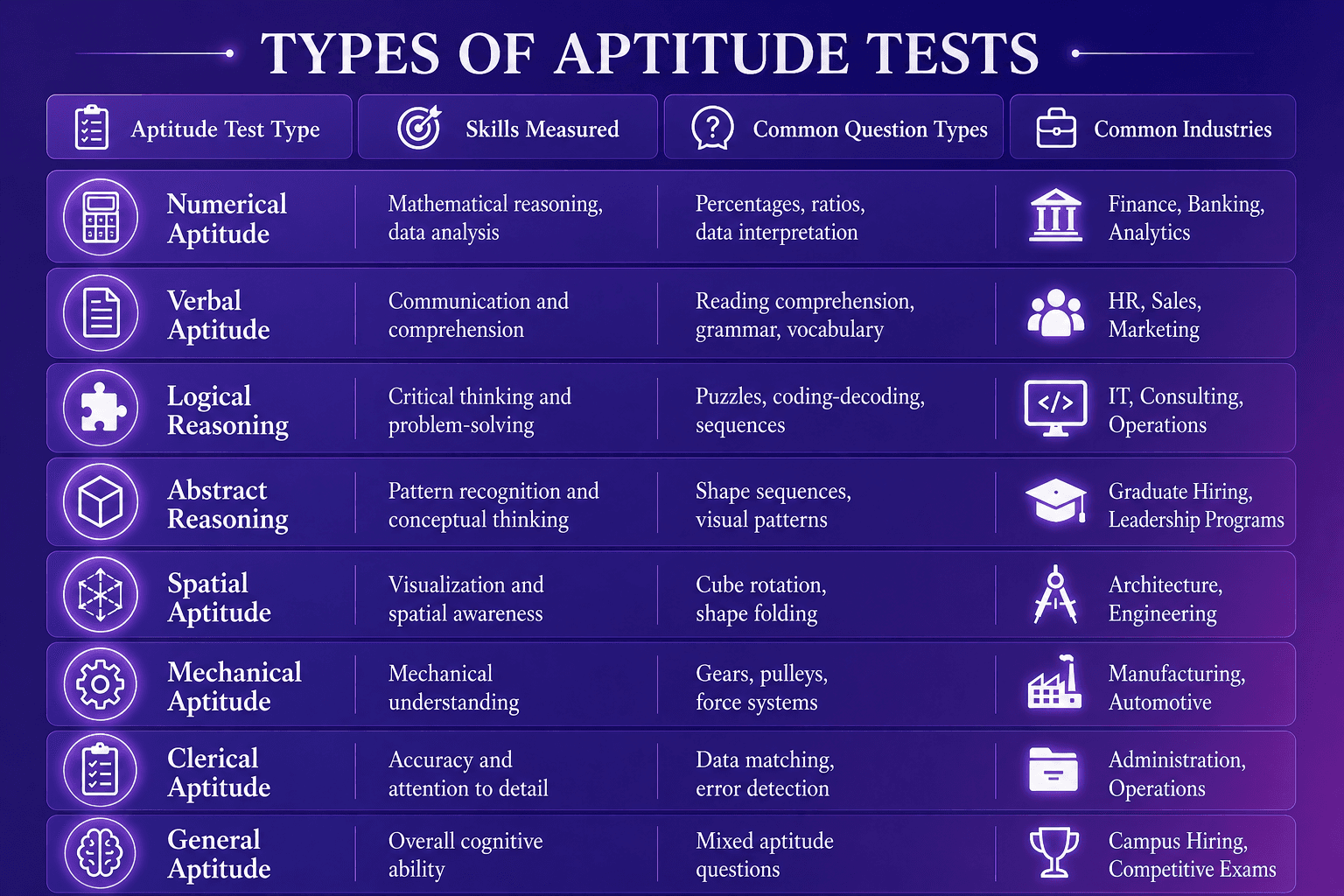
Quick Comparison of Different Types of Aptitude Tests
The following infographic provides a quick comparison of the 8 main types of aptitude tests, the skills they measure, and their most common applications in hiring and education.
What Skills Do Aptitude Tests Measure?
Aptitude tests are designed to assess a wide range of cognitive and workplace skills that influence academic, professional, and career success. Depending on the type of assessment, aptitude tests can measure everything from numerical reasoning and communication skills to problem-solving, decision-making, and spatial awareness.
These insights help employers, educators, and individuals understand strengths and areas for development.
Numerical and Mathematical Skills
Numerical aptitude tests evaluate a person's ability to work with numbers, interpret data, perform calculations, and solve quantitative problems. These skills are essential for roles in finance, analytics, accounting, and business operations.
Communication and Language Skills
Verbal aptitude tests assess reading comprehension, vocabulary, grammar, and the ability to understand and communicate information effectively. Strong communication skills are valuable across nearly every profession.
Critical Thinking Skills
Critical thinking involves evaluating information objectively, identifying assumptions, and making logical judgments. Employers often assess this skill to determine how candidates approach complex situations.
Analytical Reasoning Skills
Analytical reasoning measures a person's ability to examine information, identify patterns, and draw logical conclusions. These skills are particularly important in data-driven and strategic roles.
Problem-Solving Skills
Problem-solving skills reflect a candidate's ability to identify issues, evaluate alternatives, and develop effective solutions. Many aptitude tests include reasoning-based questions to assess this capability.
Decision-Making Ability
Decision-making skills help individuals evaluate options and choose the most appropriate course of action. Employers often assess this ability in managerial, leadership, and customer-facing roles.
Attention to Detail
Attention to detail refers to a person's ability to identify errors, inconsistencies, and important information accurately. Clerical and administrative aptitude tests commonly measure this skill.
Spatial Awareness
Spatial aptitude tests evaluate the ability to visualize objects, understand spatial relationships, and mentally manipulate shapes. These skills are valuable in engineering, architecture, design, and aviation.
Mechanical Understanding
Mechanical aptitude tests assess a candidate's understanding of machinery, tools, forces, and mechanical systems. Employers often use these assessments when hiring for engineering, manufacturing, and technical roles.
Who Should Take an Aptitude Test?
Aptitude tests are useful for anyone who wants to understand their strengths, identify suitable career paths, or evaluate their readiness for academic and professional opportunities.
These assessments provide valuable insights that can support education, career planning, recruitment, and professional development decisions.
School and College Students
Students can use aptitude tests to identify their strengths, interests, and natural abilities before selecting academic streams, courses, or career paths. These assessments can help guide informed educational and career decisions.
Freshers Preparing for Placements
Many companies include aptitude tests as part of campus recruitment and placement processes. Practicing aptitude assessments can help freshers improve their problem-solving skills and prepare for hiring tests more effectively.
Job Seekers
Job seekers can take aptitude tests to understand their strengths, identify skill gaps, and improve their chances of success in recruitment assessments. Many employers use these tests during the initial screening process.
Working Professionals
Professionals can use aptitude assessments to evaluate their strengths, identify development opportunities, and prepare for promotions, leadership roles, or new career opportunities.
Career Changers
Individuals considering a career transition can use aptitude tests to discover roles and industries that align with their natural abilities, helping them make more confident career decisions.
Organizations Hiring Talent
Employers use aptitude tests to assess candidate potential, improve hiring accuracy, reduce recruitment bias, and identify individuals who are most likely to succeed in a specific role.
Benefits of Aptitude Tests
Aptitude tests offer valuable benefits for both employers and candidates. By providing objective insights into skills, strengths, and potential, these assessments support better hiring decisions, career planning, and professional development. Whether used for recruitment or self-assessment, aptitude tests help individuals and organizations make informed decisions.
Benefits for Employers
Employers use aptitude tests to identify high-potential candidates, improve hiring efficiency, and build stronger teams. These assessments provide objective data that supports more accurate talent decisions.
Better Hiring Decisions
Aptitude tests help recruiters evaluate candidates based on their abilities rather than relying solely on resumes or interviews. This leads to more informed and data-driven hiring decisions.
Reduced Recruitment Costs
By identifying suitable candidates early in the hiring process, aptitude tests reduce the time and resources spent interviewing unqualified applicants.
Improved Employee Performance
Candidates who demonstrate strong aptitude for a role are often better equipped to learn quickly, adapt to challenges, and perform effectively in the workplace.
Faster Candidate Screening
Organizations can use aptitude tests to quickly shortlist candidates, making it easier to manage large applicant pools and accelerate the recruitment process.
2. Benefits for Candidates
Aptitude tests help individuals understand their strengths, identify development opportunities, and make more informed career decisions.
Better Career Planning
Aptitude assessments provide insights into areas where an individual is most likely to succeed, helping them choose suitable educational and career paths.
Identify Strengths and Weaknesses
The results highlight key abilities and skill gaps, allowing candidates to focus on areas that need improvement.
Improved Self-Awareness
By understanding their natural abilities and preferences, individuals can make more confident decisions about their personal and professional growth.
Increased Job Readiness
Practicing aptitude tests helps candidates strengthen problem-solving, reasoning, and analytical skills that are commonly assessed during recruitment processes.
Aptitude Tests by Industry
Different industries require different skills and competencies. As a result, organizations often use specific types of aptitude tests to evaluate abilities that are most relevant to a particular role. Understanding which aptitude tests are commonly used across industries can help candidates prepare more effectively and assist employers in selecting the right assessments.
Aptitude Tests for Software Developers
Software development roles require strong analytical thinking, logical reasoning, and problem-solving abilities. Employers often assess a candidate's ability to understand complex systems, identify patterns, and solve technical challenges efficiently.
Common Skills Assessed
Logical reasoning
Analytical thinking
Problem-solving
Numerical reasoning
Technical aptitude
Recommended Aptitude Tests
Logical Reasoning Test
Numerical Aptitude Test
Technical Aptitude Test
Abstract Reasoning Test
Aptitude Tests for Engineers
Engineering professionals frequently work with technical concepts, systems, and designs. Aptitude assessments help evaluate a candidate's technical reasoning and ability to solve practical problems.
Common Skills Assessed
Mathematical reasoning
Spatial awareness
Mechanical understanding
Analytical thinking
Problem-solving
Recommended Aptitude Tests
Numerical Aptitude Test
Spatial Aptitude Test
Mechanical Aptitude Test
Logical Reasoning Test
Aptitude Tests for Finance Professionals
Finance roles involve working with data, financial reports, calculations, and business performance metrics. Employers use aptitude tests to assess a candidate's ability to interpret numerical information and make data-driven decisions.
Common Skills Assessed
Numerical reasoning
Data interpretation
Analytical skills
Decision-making
Attention to detail
Recommended Aptitude Tests
Numerical Aptitude Test
Logical Reasoning Test
General Aptitude Test
Aptitude Tests for Sales and Marketing Professionals
Sales and marketing professionals need strong communication, persuasion, and analytical skills to understand customer behaviour and drive business growth.
Common Skills Assessed
Communication skills
Verbal reasoning
Analytical thinking
Decision-making
Problem-solving
Recommended Aptitude Tests
Verbal Aptitude Test
Logical Reasoning Test
General Aptitude Test
Aptitude Tests for Administrative Roles
Administrative professionals are responsible for managing records, processing information, and ensuring operational efficiency. Employers often prioritize accuracy and attention to detail when evaluating candidates for these roles.
Common Skills Assessed
Attention to detail
Data accuracy
Information processing
Organizational skills
Time management
Recommended Aptitude Tests
Clerical Aptitude Test
Verbal Aptitude Test
General Aptitude Test
How to Prepare for an Aptitude Test
Preparing for an aptitude test requires more than just solving practice questions. A structured preparation strategy can help improve accuracy, speed, and confidence during the assessment.
By understanding the test format, practicing regularly, and focusing on key skill areas, candidates can significantly improve their performance.
Understand the Test Format
Before taking an aptitude test, familiarize yourself with the assessment structure, question types, difficulty level, and time limits. Knowing what to expect can help reduce anxiety and improve overall performance.
Practice Different Types of Questions
Most aptitude tests include numerical, verbal, logical, abstract, or situational questions. Practicing a variety of question formats helps build familiarity and improves problem-solving speed.
Improve Time Management Skills
Aptitude tests are often timed, making speed and accuracy equally important. Regular practice under timed conditions can help candidates learn how to allocate time effectively across different sections.
Focus on Weak Areas
Identify areas where you consistently make mistakes and dedicate additional practice time to those topics. Strengthening weaker skills can have a significant impact on your overall score.
Take Mock Tests Regularly
Mock tests simulate real exam conditions and help track progress over time. They also improve confidence, identify knowledge gaps, and build test-taking endurance.
Learn Shortcut Techniques
Many aptitude questions can be solved more efficiently using shortcuts and logical approaches rather than lengthy calculations.
Numerical Aptitude Tips
Practice mental math, learn percentage and ratio shortcuts, and become comfortable interpreting tables, charts, and graphs quickly.
Verbal Aptitude Tips
Read regularly, improve vocabulary, and practice comprehension exercises to strengthen language and communication skills.
Logical Reasoning Tips
Solve puzzles, pattern-recognition exercises, and reasoning questions regularly to improve analytical thinking and problem-solving speed.
Frequently Asked Questions About Aptitude Tests
1. What is an aptitude test?
An aptitude test is a standardized assessment designed to measure a person's natural abilities, reasoning skills, problem-solving capabilities, and potential to learn new tasks. Unlike traditional exams that test acquired knowledge, aptitude tests evaluate how effectively an individual can analyze information, think critically, and adapt to new situations.
2. What is the purpose of an aptitude test?
The primary purpose of an aptitude test is to identify an individual's strengths, learning potential, and suitability for specific academic programs, careers, or job roles. Organizations use aptitude tests to make objective hiring decisions, while students and professionals use them for career planning and skill assessment.
3. What skills are measured in an aptitude test?
Aptitude tests measure a range of cognitive and workplace skills, including:
Numerical reasoning
Verbal communication
Logical reasoning
Critical thinking
Analytical skills
Problem-solving ability
Decision-making skills
Spatial awareness
Attention to detail
Mechanical understanding
The exact skills assessed depend on the type of aptitude test being administered.
4. What are the different types of aptitude tests?
The most common types of aptitude tests include:
Numerical Aptitude Tests
Verbal Aptitude Tests
Logical Reasoning Tests
Abstract Reasoning Tests
Spatial Aptitude Tests
Mechanical Aptitude Tests
Clerical Aptitude Tests
General Aptitude Tests
Each test evaluates different abilities and is used for specific educational, recruitment, or career-development purposes.
5. What is the difference between an aptitude test and an IQ test?
An aptitude test measures a person's potential to learn and perform specific tasks, whereas an IQ test measures overall intellectual ability and cognitive intelligence. Aptitude tests are commonly used in hiring and career guidance, while IQ tests are primarily used for psychological assessment and research.
6. Why do companies use aptitude tests during recruitment?
Companies use aptitude tests to:
Screen large numbers of applicants efficiently
Evaluate candidates objectively
Reduce hiring bias
Assess reasoning and problem-solving skills
Predict future job performance
Improve the quality of hiring decisions
These assessments help employers identify candidates who are most likely to succeed in a role.
7. Which aptitude test is best for placements?
The best aptitude test for placements depends on the job role and industry. However, most campus recruitment processes include:
Numerical Aptitude Tests
Verbal Aptitude Tests
Logical Reasoning Tests
General Aptitude Tests
Technology companies may also include coding and analytical reasoning assessments, while finance roles often emphasize numerical aptitude.
8. What are the most common aptitude test questions asked by companies?
Companies frequently include questions related to:
Percentages and ratios
Profit and loss
Data interpretation
Reading comprehension
Vocabulary and grammar
Logical puzzles
Number and letter series
Coding-decoding
Syllogisms
Pattern recognition
These questions help assess a candidate's reasoning, analytical thinking, and decision-making abilities.
9. How long does an aptitude test take?
Most aptitude tests take between 20 and 90 minutes, depending on the assessment type and complexity. Recruitment aptitude tests typically last 30–60 minutes, while comprehensive psychometric and career aptitude assessments may take longer.
10. Can aptitude tests be taken online?
Yes. Most modern aptitude tests are conducted online through secure assessment platforms. Online aptitude tests offer benefits such as remote accessibility, instant scoring, faster evaluation, and scalability for large recruitment drives.
11. How can I prepare for an aptitude test?
To prepare effectively for an aptitude test:
Understand the test format and syllabus.
Practice numerical, verbal, and logical reasoning questions.
Take mock tests regularly.
Improve speed and accuracy.
Focus on weak areas.
Learn shortcuts for calculations and problem-solving.
Manage time effectively during practice sessions.
Consistent practice is one of the most effective ways to improve aptitude test performance.
12. Are aptitude tests difficult to pass?
Aptitude tests are designed to evaluate reasoning and problem-solving skills rather than memorized knowledge. While some questions can be challenging, candidates who practice regularly and understand common question formats generally find them manageable.
13. What is a good aptitude test score?
A good aptitude test score varies depending on the employer, industry, and assessment provider. Many organizations use percentile rankings or benchmark scores. Generally, scoring above the 70th percentile is considered competitive, while top employers may look for scores above the 85th percentile.
14. Can aptitude tests predict job performance?
Yes. Aptitude tests are considered one of the strongest predictors of future job performance because they assess reasoning ability, learning agility, and problem-solving skills. Many employers use them alongside interviews and technical assessments to improve hiring accuracy.
15. How accurate are aptitude tests in predicting success?
Aptitude tests are highly effective at measuring cognitive abilities and learning potential. While no assessment can predict success with complete certainty, aptitude tests provide valuable insights when combined with experience, interviews, and role-specific evaluations.
16. Is an aptitude test the same as a psychometric test?
No. Aptitude tests are a subset of psychometric tests. Aptitude tests measure cognitive abilities such as reasoning and problem-solving, while psychometric tests may also assess personality traits, behavioral tendencies, emotional intelligence, and work preferences.